
Ingredient glossary
Petrolatum
On your shelf ✓What Petrolatum does for your skin, who it suits, and what to watch for.
INCI: Petrolatum
In short: Petrolatum delivers barrier support, suits dry skin best, and the evidence behind it is strong.
- What it does
- Barrier support
- Best for
- Dry skin
- Evidence
- Strong
- How long
- Straight away
What it actually is
The Glow take
One of the ingredients I trust most.
When your goal is repairing a stressed moisture barrier, Petrolatum delivers, and the research properly backs it up. It tends to suit dry skin best.
— Maya
What it does
- barrier support
strong evidenceConsidered a gold-standard occlusive in dermatology literature for preventing transepidermal water loss and aiding barrier repair.
Who it's for, and who should skip it
Tends to suit
- very dry
- compromised barrier
Approach with care
- acne prone if thick layer
- oily
- Irritation riskLow
How it fits each skin type
- DrySuits
- CombinationNeutral
- OilyTake care
- SensitiveNeutral
Often chosen for compromised barrier. Take extra care if any of these apply to you: acne prone (in thick layers).
Where it fits in your routine
This one works on contact — there is nothing to wait for.
What that covers, and what it does not
Measured on: transepidermal water loss by evaporimetry, read within minutes to an hour of application.
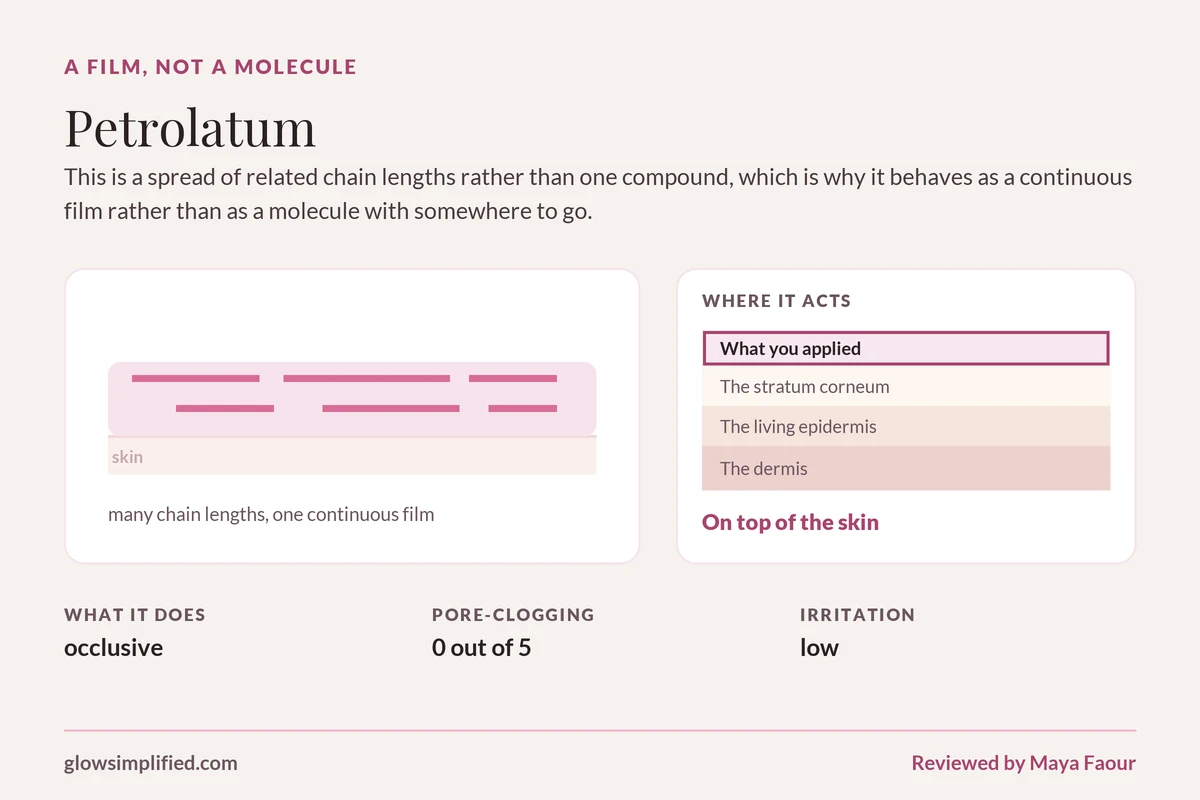
Petrolatum is the reference occlusive against which others are ranked: applied to human skin it cuts water loss sharply as soon as the film sets, and it also permeates into the stratum corneum interstices. That drop is measured by evaporimetry, not inferred, and it holds only while the film is there - it leaves with the next cleanse, so the result is maintained by reapplication rather than accumulated. Slower clauses on the same ingredient: barrier recovery after damage is accelerated over the following day or two, and visible relief of xerosis takes days of use. Concentration is not a variable in the usual sense - the effect scales with how much film is left on the skin.
Settled occlusive consensus in dermatology, with Ghadially, Halkier-Sorensen & Elias, J Am Acad Dermatol 1992 (effects of petrolatum on stratum corneum structure and function, human tape-stripped skin) as the exemplar human study. No PMID given.
Plays well with
- humectants
- ceramides
Petrolatum, answered
Is Petrolatum safe during pregnancy?
Yes. Petrolatum is considered safe to use during pregnancy and breastfeeding. As with anything, if you are unsure it is worth a quick word with your doctor or midwife.
Who should avoid Petrolatum?
Approach Petrolatum with care if any of these apply to you: acne prone (in thick layers) and oily.
What concentration of Petrolatum actually works?
Its concentration is rarely printed on the label, so use the ingredient list as your clue: near the top third it is likely doing real work, near the bottom it is more of a sprinkle.
Does it clog pores?
Inert and non-reactive; rates at the bottom of the scale.
- This rating comes from old lab tests on the isolated ingredient, not the finished product.
- The full formula, how much is used, and your own skin all matter more than one number.
- If you are acne-prone it is worth noticing, not a reason to avoid it on sight.
Checking a whole product? Paste its list into the pore-clogging checker →
Commonly confused with
- Mineral OilSame inert, non-reactive source. Petrolatum is the thick jelly that seals; mineral oil is the pourable liquid version.
This, for every label you own
One ingredient is easy. A full label is where it gets confusing. The Ingredient Decoder reads any product and tells you the honest truth, ingredient by ingredient.