
How skin works
Retinal is one step closer than retinol
Neither one does anything until your skin has converted it into retinoic acid. Retinal, written retinaldehyde on ingredient lists, needs one conversion. Retinol needs two. Every other retinoid on the shelf is somewhere on the same ladder, and knowing where is most of what there is to know.
The short answer
Fewer steps means closer to working, not automatically stronger, and our own scores say so.
- What is the actual difference?
- Retinal is one conversion away from retinoic acid, the form that does the work. Retinol is two. That is the difference, and it is the only one that is structural rather than a matter of how a product was made.
- So is retinal stronger?
- Our knowledge base scores them the same on efficacy, 9 out of 10 each. Being closer to the active form is a fact about the molecule, not a measured result, and we are not going to convert one into the other for you.
- Which is gentler?
- Retinal. We rate its irritation risk moderate, against high for the other one.
- Which has more behind it?
- Retinol, on strong evidence against moderate. The older ingredient has been studied for longer, which is worth something on its own.
- Can I use either in pregnancy?
- No. Every retinoid in our glossary, all 10 of them, is flagged to avoid in pregnancy. This is the one place on this page where the answer does not depend on how many steps anything is from anything.
The whole family is one molecule, at different distances
There is only one retinoid that actually does the work, and it is retinoic acid. Everything else you can buy is a form of vitamin A that your skin has to convert, or a synthetic molecule built to fit the same receptor. The number of conversions between the bottle and the working form is the single most useful thing to know about any of them.
Each conversion costs something. Some of what you applied never makes it to the next rung: it gets stored, or shed with the surface, or simply never converted. That is why a retinyl ester at the same percentage as retinal is not the same treatment, and it is also why the gentler forms are gentler. Less arrives.
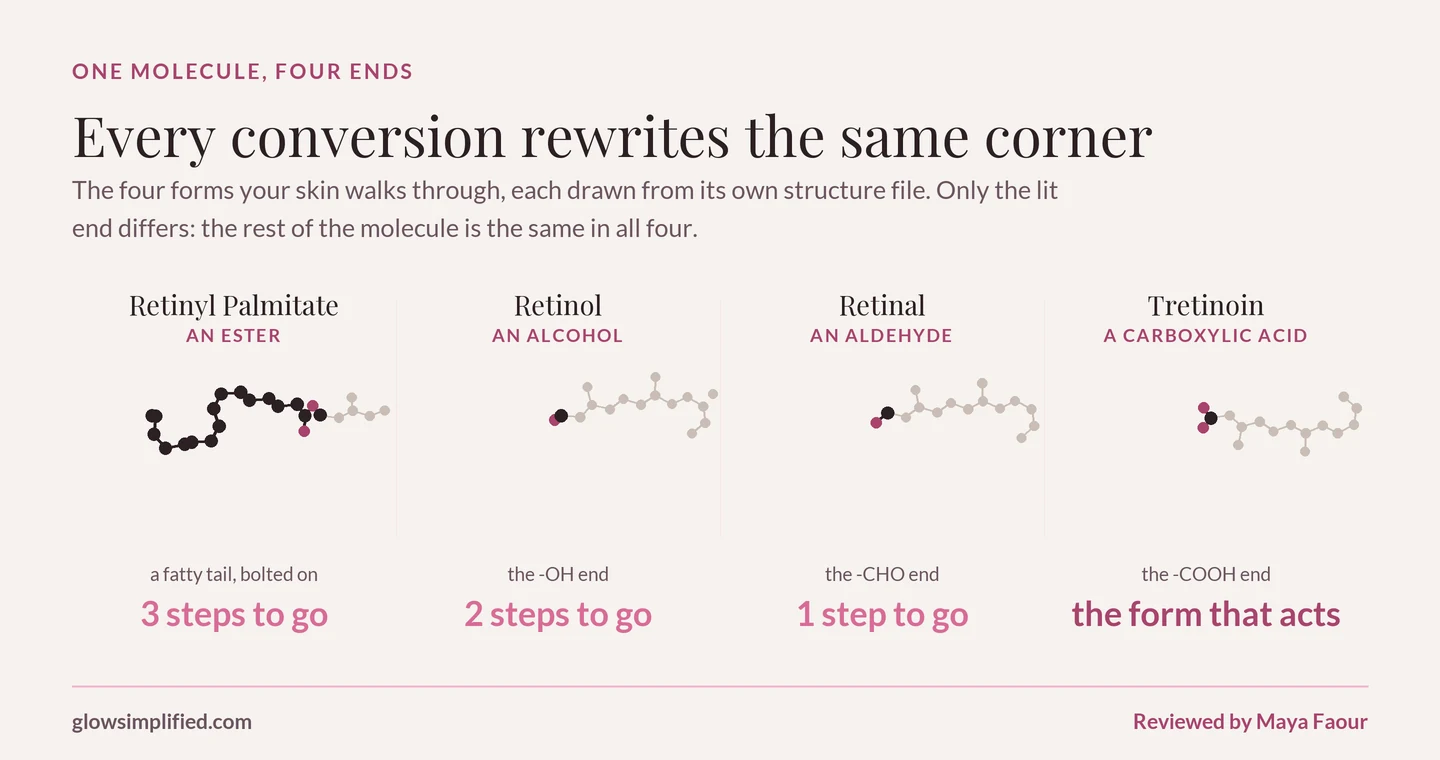
And a conversion is a smaller thing than it sounds. The four forms are the same molecule with one corner rewritten: an ester carries a fatty tail, retinol an alcohol, retinal an aldehyde, and retinoic acid a carboxylic acid. Everything else, the ring and the long chain that does the actual work at the receptor, is identical in all four.
What that means for retinol against retinal
Retinal sits one rung below retinol, so it arrives at the working form having lost one conversion less. That is a real difference and it is a mechanical one. What it is not is a measured statement about results, and this is where most of what you will read goes wrong.
Our own knowledge base scores Retinol and Retinal at 9 and 9 out of 10 on efficacy. The same number. Where they separate is on the two things a person actually feels and can check: Retinal carries the moderate irritation rating against high for Retinol, and Retinol has the longer research record, strong against moderate.
So the honest summary is that retinal is the closer one and the kinder one, and retinol is the better documented one. If somebody tells you retinal is a multiple of retinol at the same percentage, ask what was measured. We could not find it, so we do not print it.
Retinol
2 steps to active
- Efficacy
- 9 / 10
- Irritation
- high
- Evidence
- strong
- Pregnancy
- avoid
Retinal
1 step to active
- Efficacy
- 9 / 10
- Irritation
- moderate
- Evidence
- moderate
- Pregnancy
- avoid
All 10, drawn at one scale
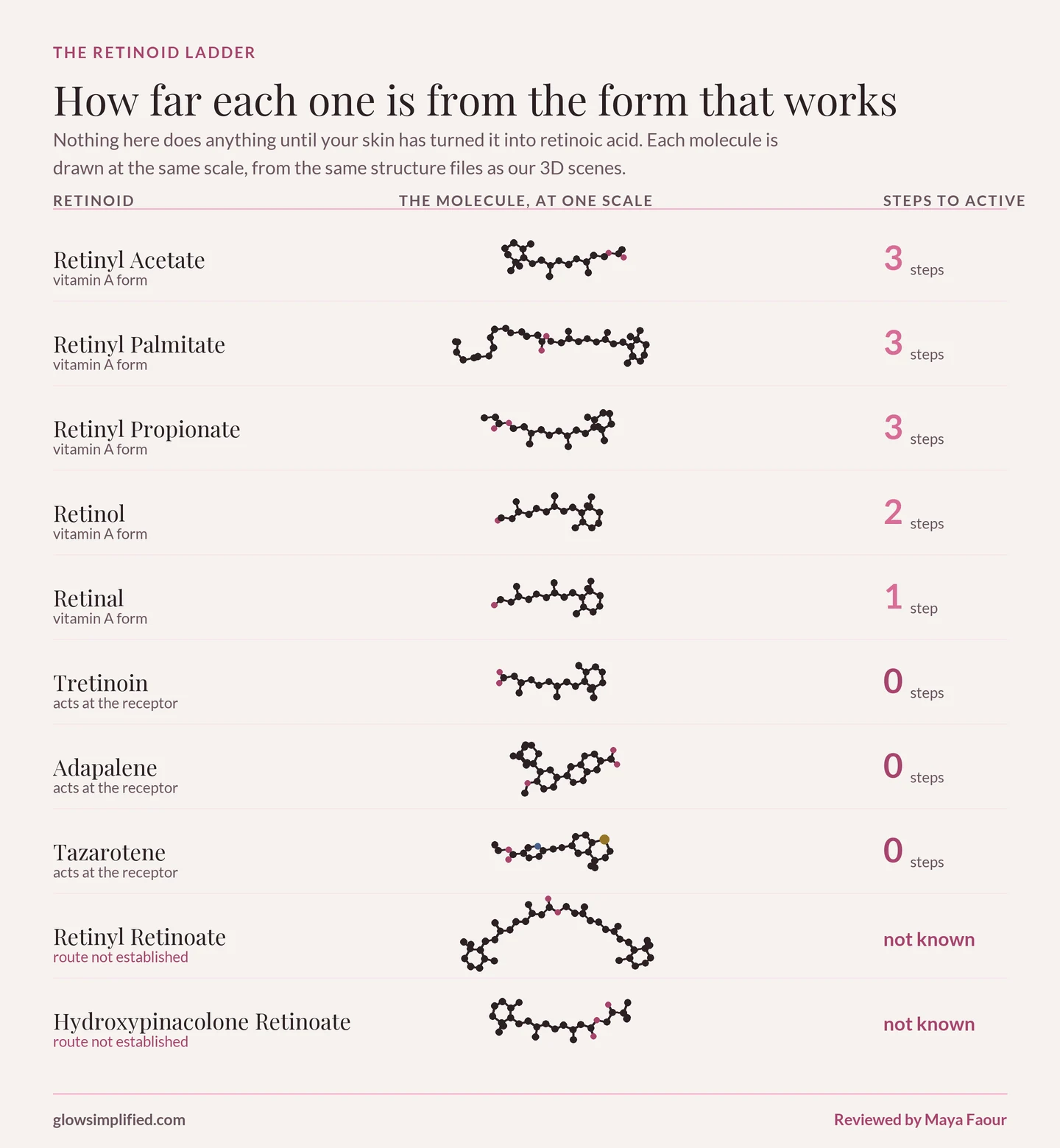
The same ladder, with every retinoid our glossary holds and each molecule drawn from the same structure file its 3D scene uses, at one shared scale. Retinyl palmitate is drawn longest because it is longest: it is retinol with a sixteen-carbon tail bolted on, and that tail is the first thing the skin has to take off again.
| Retinoid | Steps | Efficacy | Irritation | Evidence |
|---|---|---|---|---|
| Retinyl Acetate | 3 | 5 / 10 | low | weak |
| Retinyl Palmitate | 3 | 6 / 10 | low | moderate |
| Retinyl Propionate | 3 | 5 / 10 | low | emerging |
| Retinol | 2 | 9 / 10 | high | strong |
| Retinal | 1 | 9 / 10 | moderate | moderate |
| Tretinoin | 0 | 10 / 10 | high | strong |
| Adapalene | 0 | 9 / 10 | moderate | moderate |
| Tazarotene | 0 | 9 / 10 | high | strong |
| Retinyl Retinoate | not known | 8 / 10 | moderate | emerging |
| Hydroxypinacolone Retinoate | not known | 8 / 10 | low | emerging |
5 of them are vitamin A forms your skin has to work on. 3 skip the ladder altogether: tretinoin already is retinoic acid, and adapalene and tazarotene are synthetic molecules that act at the same receptor without being vitamin A at all. All three are prescription or pharmacy products in most countries, which is the trade for having no conversion to lose.
The 2 we could not place
Two of the 10 have no step count on this page, and they are the two whose route is stated most confidently everywhere else.
- Retinyl Retinoate. A hybrid of retinol and retinoic acid. It has wrinkle trials behind it and no published route.
- Hydroxypinacolone Retinoate. Sold as needing no conversion. We could find no study measuring what the skin does with it.
We looked. There are clinical trials on retinyl retinoate with wrinkle endpoints, and there is a supplier literature for hydroxypinacolone retinoate that asserts it binds the receptor directly. What we could not find, in either case, is a study measuring what skin actually does with the molecule. So the column says not known, which is a worse-looking answer and the only one we can stand behind.
Which of these you can actually buy
From our own product decodes: 8 of the products we have taken apart carry a retinoid, and they cluster on three rungs of the ladder.
- Medik8 Crystal Retinal 6
- Geek & Gorgeous A-Game 10
- Celimax The Vita A Retinal Shot Tightening Booster
- The Ordinary Retinol 0.5% in Squalane
- CeraVe Resurfacing Retinol Serum
- The Ordinary Granactive Retinoid 2% Emulsion
- Paula's Choice Clinical 0.3% Retinol + 2% Bakuchiol Treatment
- The Ordinary Granactive Retinoid 5% in Squalane
Compare two of them
- Retinal vs Retinol
- Hydroxypinacolone Retinoate vs Retinol
- Retinol vs Retinyl Palmitate
- Retinol vs Retinyl Acetate
- Retinol vs Retinyl Propionate
- Retinol vs Retinyl Retinoate
- Hydroxypinacolone Retinoate vs Retinal
- Retinal vs Retinyl Palmitate
- Retinal vs Retinyl Acetate
- Retinal vs Retinyl Propionate
- Retinal vs Retinyl Retinoate
- Adapalene vs Retinol
Can you mix a retinoid with
Sources
The step counts on this page are not ours. Each one is here because a paper says so, and every identifier below was resolved through PubMed on August 2026 before it was written down. Where the abstract stopped short of the claim, so did we.
- Szymański et al. 2020, Cells. All-trans retinoic acid is the active metabolite of the group, and the receptors are what it acts on.PMID 33322246, abstract only, the full text is paywalled
- D'Ambrosio et al. 2011, Nutrients. Retinoid metabolism runs through retinyl esters, retinol, retinal and retinoic acid as distinct forms.PMID 21350678, abstract only, the full text is paywalled
- Sorg, Didierjean and Saurat 1999, Dermatology. Keratinocytes convert topical retinaldehyde into retinoic acid, and most of a topical dose becomes stored retinyl esters instead.PMID 10473954, abstract only, the full text is paywalled
- Mukherjee et al. 2006, Clinical Interventions in Aging. Tretinoin is the most investigated retinoid for photoageing, and irritation is what limits how well retinoids are tolerated.PMID 18046911, abstract only, the full text is paywalled
- Kassir et al. 2020, Journal of Cosmetic Dermatology. A class of topical retinoids acts as selective agonists at the retinoic acid receptor itself.PMID 32100454, abstract only, the full text is paywalled
Ratings, scores and pregnancy flags come from our own knowledge base entries for each ingredient, which carry their own citations on their own pages.
Corrections and updates
Nothing has been corrected on this page since it was published. If that changes, the change will be listed here with its date rather than quietly edited in.
Last re-read against its sources on . If you find an error, tell us and we will fix it and say so.
Get the next one
We read the primary papers, write to the researchers, and print what they say. If that is useful, the free plain-words routine guide comes with it. No spam, and nothing sold here.