Ingredient glossary
Hyaluronic acid
On your shelf ✓What Hyaluronic acid does for your skin, who it suits, and what to watch for.
INCI: Sodium Hyaluronate · Also: HA
In short: Hyaluronic acid delivers hydration, suits most skin types, and the evidence behind it is strong.
- What it does
- Hydration
- Best for
- Most skin types
- Evidence
- Strong
- How long
- Straight away
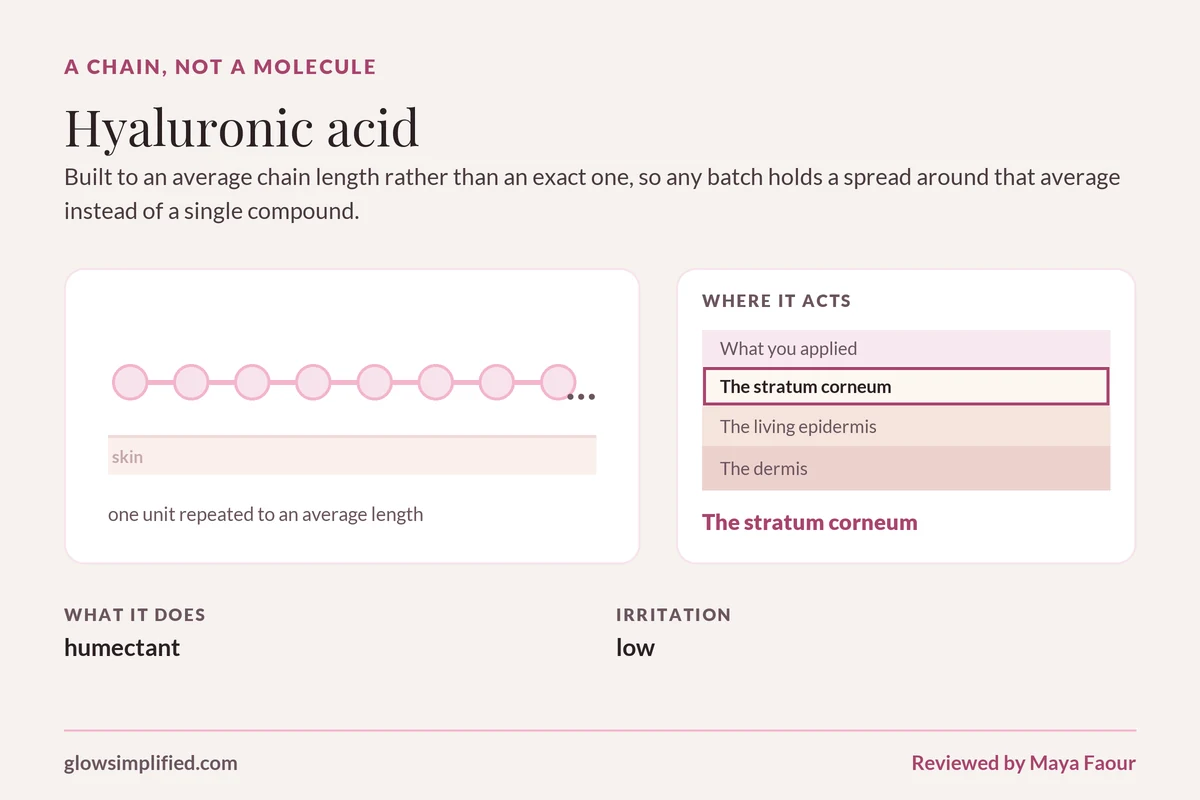
What it actually is
The Glow take
One of the ingredients I trust most.
When your goal is deep, lasting hydration, Hyaluronic acid delivers, and the research properly backs it up. Gentle enough that most skin types can reach for it.
— Maya
What it does
- hydration
strong evidenceGood evidence that it increases skin hydration, especially in leave-on products, though long-term anti-aging benefits are modest.
Who it's for, and who should skip it
Tends to suit
- dry
- dehydrated
- all
Approach with care
No specific group flagged to avoid it.
- Clogs poresLow
- Irritation riskLow
How it fits each skin type
- DrySuits
- CombinationSuits
- OilySuits
- SensitiveSuits
Where it fits in your routine
This one works on contact — there is nothing to wait for.
What that covers, and what it does not
Measured on: stratum corneum hydration, corneometer capacitance after a single application.
Sodium hyaluronate forms a hygroscopic surface film that holds water against the skin, so the capacitance reading moves on contact; high molecular weight material does not cross the stratum corneum, so nothing deeper is being remodelled in that window. The other outcome the base hints at (anti_aging 1) is slower and weaker: topical 0.1% HA creams of differing molecular weight reported hydration, elasticity and wrinkle-depth improvement over an 8-week course. That trial used a specific low-MW fraction, not the generic HA in most serums.
Pavicic et al., J Drugs Dermatol 2011 (0.1% hyaluronic acid creams of different molecular weights, 8 weeks) for the wrinkle/elasticity arm. No named trial for the on-contact hydration rise; no PMID given.
Plays well with
- occlusives
- emollients
Hyaluronic acid, answered
Is Hyaluronic acid safe during pregnancy?
Yes. Hyaluronic acid is considered safe to use during pregnancy and breastfeeding. As with anything, if you are unsure it is worth a quick word with your doctor or midwife.
Who should avoid Hyaluronic acid?
No specific group is flagged to avoid Hyaluronic acid. It is well tolerated by most skin. Still, introduce anything new one product at a time.
What concentration of Hyaluronic acid actually works?
Its concentration is rarely printed on the label, so use the ingredient list as your clue: near the top third it is likely doing real work, near the bottom it is more of a sprinkle.
Commonly confused with
- Polyglutamic AcidBoth are humectants that pull in water. Polyglutamic acid holds even more and sits on top; hyaluronic draws moisture in.
Compare Hyaluronic acid with
- Pro-vitamin B5
- Sodium PCA
- Aloe
- Butylene Glycol
- Propanediol
- Betaine
- Trehalose
- Xylitol
- Hydroxyethyl Urea
- Glycereth-26
- Polyglutamic Acid
- Tremella Fuciformis Extract
- Beta-Glucan
- Hydrolyzed Collagen
- Honey
- Pentylene Glycol
- Crosslinked sodium HA
- Propylene Glycol
- Hydrolyzed hyaluronic acid
- Acetylated Hyaluronic Acid
- Fructooligosaccharides
- Hexylene Glycol
- Retinol
- Niacinamide
- Salicylic acid (BHA)
- Azelaic Acid
This, for every label you own
One ingredient is easy. A full label is where it gets confusing. The Ingredient Decoder reads any product and tells you the honest truth, ingredient by ingredient.