Ingredient glossary
Crosslinked sodium HA
On your shelf ✓What Crosslinked sodium HA does for your skin, who it suits, and what to watch for.
INCI: Sodium Hyaluronate Crosspolymer · Also: Crosslinked hyaluronic acid, HA crosspolymer
In short: Crosslinked sodium HA delivers hydration and barrier support, suits dry and sensitive skin best, and the evidence behind it is strong.
- What it does
- Hydration, barrier support
- Best for
- Dry, Sensitive skin
- Evidence
- Strong
- How long
- Straight away
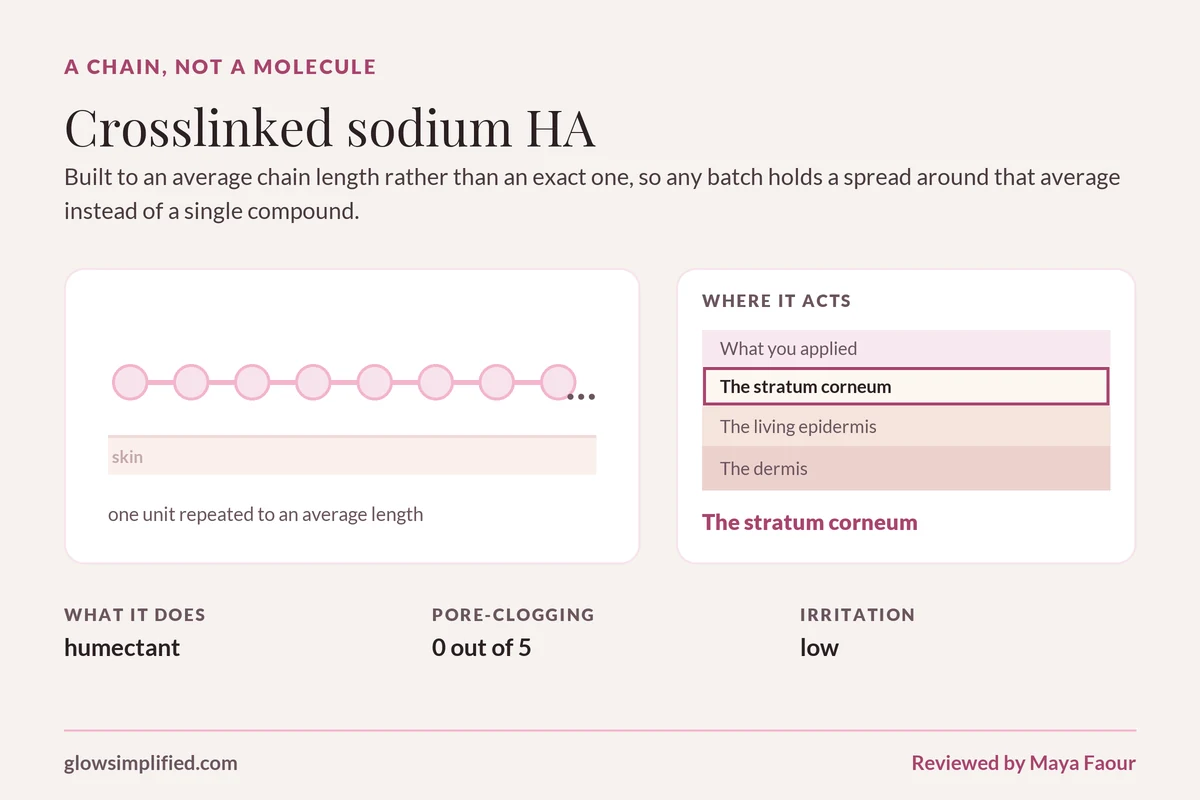
What it actually is
The Glow take
One of the ingredients I trust most.
When your goal is deep, lasting hydration, Crosslinked sodium HA delivers, and the research properly backs it up. It tends to suit dry skin best.
— Maya
What it does
- hydration
- barrier support
- anti aging
strong evidenceTrials of formulas combining the crosspolymer with other hyaluronic acid fractions report better hydration, elasticity and wrinkle scores than placebo. The benefit is hydration driven and belongs to the whole formula, not the crosspolymer alone.
On a label: usually effective at 0.1-0.5%.
Who it's for, and who should skip it
Tends to suit
- dry
- dehydrated
- very dry
- compromised barrier
- mature
- sensitive
- rosacea
Approach with care
No specific group flagged to avoid it.
- Irritation riskLow
How it fits each skin type
- DrySuits
- CombinationNeutral
- OilyNeutral
- SensitiveSuits
Often chosen for compromised barrier, mature, rosacea.
Where it fits in your routine
This one works on contact — there is nothing to wait for.
What that covers, and what it does not
Measured on: surface hydration and optical smoothing while the swollen gel film is in place (corneometry).
A crosslinked hyaluronate network swells with water and sits as a hydrated film, holding water from the moment it is applied - an on-contact physical mechanism, and the base's own wording is that it softens fine lines 'while it is in place'. The multi-week elasticity and wrinkle results the base cites come from formulas combining the crosspolymer with other HA fractions and other actives, so they cannot be assigned to this ingredient or used to date its onset. No trial has tested the crosspolymer alone against its own vehicle with interim visits.
Formula-level combination HA trials described in the base row; no isolated crosspolymer trial identified.
Plays well with
- humectants
- occlusives
- ceramides
- panthenol
- niacinamide
- hyaluronic acid
Crosslinked sodium HA, answered
Is Crosslinked sodium HA safe during pregnancy?
Yes. Crosslinked sodium HA is considered safe to use during pregnancy and breastfeeding. As with anything, if you are unsure it is worth a quick word with your doctor or midwife.
Who should avoid Crosslinked sodium HA?
No specific group is flagged to avoid Crosslinked sodium HA. It is well tolerated by most skin. Still, introduce anything new one product at a time.
What concentration of Crosslinked sodium HA actually works?
Crosslinked sodium HA tends to do its job in the 0.1 to 0.5% range. Much lower and it is likely underdosed.
Does it clog pores?
No rating published; crosslinked HA is not pore clogging.
- This rating comes from old lab tests on the isolated ingredient, not the finished product.
- The full formula, how much is used, and your own skin all matter more than one number.
- If you are acne-prone it is worth noticing, not a reason to avoid it on sight.
Checking a whole product? Paste its list into the pore-clogging checker →
Compare Crosslinked sodium HA with
- Hyaluronic acid
- Pro-vitamin B5
- Sodium PCA
- Aloe
- Butylene Glycol
- Propanediol
- Betaine
- Trehalose
- Xylitol
- Hydroxyethyl Urea
- Glycereth-26
- Polyglutamic Acid
- Tremella Fuciformis Extract
- Beta-Glucan
- Hydrolyzed Collagen
- Honey
- Pentylene Glycol
- Propylene Glycol
- Hydrolyzed hyaluronic acid
- Acetylated Hyaluronic Acid
- Fructooligosaccharides
- Hexylene Glycol
Can you mix Crosslinked sodium HA with
This, for every label you own
One ingredient is easy. A full label is where it gets confusing. The Ingredient Decoder reads any product and tells you the honest truth, ingredient by ingredient.