CeraVe SA Lotion for Rough & Bumpy Skin On your shelf ✓
$0.04 an application · about 450 usesOur review, in one look
Salicylic acid (BHA) is the reason to consider this moisturizer, with Ceramide 3 behind it.
The case for it
- Salicylic acid (BHA), moderate evidence for oil and breakouts
- Ceramide 3, strong evidence for the barrier
- No fragrance or alcohol
Mind this
- Sunscreen the next day, acids leave skin more sun-sensitive
- Add it on its own for a week or two, so you know what your skin is answering to
 Maya's read
CeraVe SA Lotion for Rough & Bumpy Skin is a moisturizer built around Glycerin, Salicylic acid (BHA) and Ceramide 3. It leans strongest on hydration, barrier repair, oil-control & blemishes. Best suited to dry, dehydrated and oily skin. Go slow: the active is potent enough to irritate if overused.
Cost per use: what a day of it costs
$0.04 an applicationabout 450 uses from 562 ml
measured: 2.5 fingertip units for face and neck, about 1.25 g; from $20 as read in September 2026 and a 562 ml pack.
how this is counted
About $0.04 an application, about 450 uses from 562 ml.
- Long & Finlay 1991, Clin Exp Dermatol: face and neck 2.5 fingertip units (PMID 1806320, abstract read)
- Long, Finlay & Averill 1992, Arch Dermatol: 4 hand areas = 2 FTU = 1 g (PMID 1497374)
- Finlay, Edwards & Harding 1989, Lancet: the fingertip unit defined (PMID 2567912, a letter)
- density taken as 1 g per ml: assumed, as on the sunscreen calculator
- Measured or assumed: the rule, and the dose table
Skip it if your barrier is already sensitised or compromised: the acids can sting broken or over-exfoliated skin.
Fragrance, texture and film: what the label says of its feel
- fragrance-free by the label: no parfum, none of the 26
- a moisturiser in a pump
- leaves a film: mineral oil, dimethicone
Facts off the label and the pack only. How it feels on a face is not something this page will say without having used it.
The formula, in order
every ingredient at its place on the label
Coloured by the job each one does here.
14 of the 26 sit above the 1% line. The other 12, hatched, are each under 1%. Widths show the ORDER on the label and nothing else: the label never discloses amounts, so we never draw them.
- Actives & signals
- Hydrators
- Texture & base
- Preservation
- Not in our library yet
- fed it in culture
- fed M. furfur only
- inferred from the chain length
- did not feed it
- never tested
- No fragrance anywhere on the label
Fungal acne: what on this label feeds the yeast (Malassezia)
the yeast: Malassezia furfur, globosa, restricta
4 ingredients on this label fed Malassezia in culture (glyceryl stearate, PEG-100 stearate, cetearyl alcohol, mineral oil), 2 are inferred to; the follicle species grew on three of them; mineral oil: M. furfur only, not the folliculitis species.
Each result is a pure ingredient on a lab dish, never this product on skin.
where this comes from
- mineral oilM. furfur only
This species is able to grow in the presence of paraffin liquidum and squalene, but its growth is significantly slower than on other growth media.
DOI 10.3390/cosmetics6030045 - glyceryl stearate
The growth of all Malassezia spp. in the presence of free acids, free acid esters, and fatty alcohols with a fatty chain length above 12 carbon atoms was observed.
DOI 10.3390/cosmetics6030045 - PEG-100 stearate
PEG-glyceryl stearate (Tagat S2) and macrogol-50 stearate (Myrj 53) were metabolized by all strains, while PEG-35 castor oil (Cremophor EL) was metabolized only by M. furfur.
PMID 9292068 - cetearyl alcohol
Unexpectedly, the growth of some Malassezia spp., especially M. furfur, was observed in the presence of a primary fatty alcohol, cetylstearyl alcohol.
DOI 10.3390/cosmetics6030045 - cetyl alcoholInferred from the chain length: The growth of all Malassezia spp. in the presence of free acids, free acid esters, and fatty alcohols with a fatty chain length above 12 carbon atoms was observed.DOI 10.3390/cosmetics6030045
- sodium lauroyl lactylateInferred from the chain length: The yeast, Pityrosporum orbiculare, isolated from lesions from lesions of tinea versicolor, grows in vitro only if fatty acids from the C12 to C24 series are added to the culture medium.PMID 1249447
What does it do? What its ingredients deliver
How it feels A rich, cushiony cream that sinks in slowly. Comforting on dry skin, possibly too much for oily skin in summer. (estimated from the formula)
Key ingredients: what in it does the work
Classic humectant with strong evidence for improving skin hydration and supporting barrier when combined with emollients.
Glycerin: This one works on contact: there is nothing to wait for.
how it was measured
Measured on stratum corneum hydration, corneometer capacitance after a single application; on contact, by mechanism.
Oil-soluble exfoliant that penetrates pores to reduce blackheads and breakouts; can be drying or irritating if overused.
Skin-identical ceramide that plays a key role in restoring and strengthening the skin barrier.
Highly purified mineral oil that forms an occlusive layer to reduce water loss and soften very dry skin.
Ceramide that supports barrier integrity and helps smooth rough, dry skin when combined with other skin lipids.
Structural ceramide important for a resilient, well-organized barrier lipid matrix.
What only this label says
Salicylic acid (BHA) is the 5th of 26 ingredients: above the 1% line.
why
Position 5 of 26 on the label as printed; compared with the 18 other labels in the catalogue that carry a BHA.
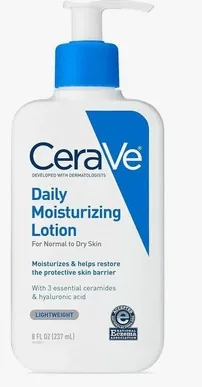
Shares 4 of its 6 known actives with CeraVe Daily Moisturizing Lotion: the closest formula we have.
why
Actives our base knows on both labels: Glycerin, Ceramide 3, Ceramide 6-II and Ceramide 1.
5 of the 6 actives carry strong evidence in our base (Glycerin, Ceramide 3, Mineral Oil, Ceramide 6-II and Ceramide 1); Salicylic acid (BHA) is moderate.
why
evidence_level in our base, per row, as printed on each glossary page.
Water, then glycerin: a light, water-led base.
why
The first two ingredients on the label, in the order printed; the second's role is read from its name (a row in our base).
14 ingredients sit above the 1% line; from Carbomer down, the order stops telling you anything.
why
The 1% line is inferred from Carbomer at position 15 (see The formula, drawn).
why
Floor 0.5%, the pad maker's own reading: A review of four clinical studies and a comedolytic assay attests to the efficacy and safety of 0.5% and 2% solutions of salicylic acid for the treatment of acne vulgaris. (Zander 1992: three placebo-controlled pad studies at 0.5% and 2%, unpublished, summarised by the maker; the US 0.5 to 2% acne monograph, 21 CFR 333.310, rests on them). Position on the label.
Fragrance allergens: the ones this label names
This label names none of the 26 EU fragrance allergens. What the 26 are →
How to use it, and when
In the evening, and not every night: 2–3 times a week is plenty. Follow with a moisturiser, and wear sunscreen the next day.
What not to layer it with
- Retinoids (retinol, tretinoin)
- Benzoyl peroxide
- Other exfoliating acids the same night
Where in your skin it works
All 7 of its placed actives act on or in the dead surface layer, none below it: the same cross-section as our 500 dalton page, with this formula's actives on the layer each one works on. Depth is the anatomy's, never an ingredient's.
Skin surface
The stratum corneum
- Ammonium lactatederived from what it is
- Ceramide 1derived from what it is
- Ceramide 3derived from what it is
- Ceramide 6-IIderived from what it is
- Glycerinderived from what it is
- Mineral Oilderived from what it is
- Salicylic acid (BHA)derived from what it is
7 of this product's actives have a layer we can defend.
How it compares with the average moisturizer
It scores higher than the median moisturizer on oil control.
On hydration, barrier repair, brightening and anti-aging it is level with the median, so that is not what sets it apart.
A median, not an average: one unusual formula should not move the middle. The numbers are the same 0 to 10 reads the comparison pages use.
Full ingredients list, decoded
23 of these 26 ingredients are in our library, linked and named for what each one does, with anything that can irritate or clog flagged; the 3 we cannot place are left plain, nothing is hidden. Every ingredient on the label, in the order it appears (highest amount first).
All 26 ingredients, decoded
- Aqua / Water / EauSolvent (base)
- GlycerinHumectant
- TriethanolaminePh adjuster
- Salicylic AcidExfoliantmild irritant
- Glyceryl StearateEmulsifier
- Ammonium LactateExfoliantmild irritant
- PEG-100 StearateEmulsifier
- Cetearyl AlcoholEmollient
- Cetyl AlcoholEmollient
- Zea Mays Oil / Corn OilPlant oil / butter (emollient)
- Ceramide NPBarrier lipid
- Ceramide APBarrier lipid
- Ceramide EOPBarrier lipid
- roughly the 1% lineThe rules only require descending order above 1%. From Carbomer down, these 12 can be listed in any order the brand likes, so position stops telling you anything.
- CarbomerThickener
- Behentrimonium MethosulfateConditioning agent
- DimethiconeOcclusive
- MethylparabenPreservative
- Sodium Lauroyl LactylateSurfactantmild irritant
- Cholecalciferol
- CholesterolBarrier lipid
- Disodium EDTAChelator
- PropylparabenPreservative
- Hydrolyzed Hyaluronic AcidHumectant
- PhytosphingosineSphingoid base
- Xanthan GumThickener
Copy the raw INCI list
Aqua / Water / Eau, Glycerin, Paraffinum Liquidum / Mineral Oil / Huile Minerale, Triethanolamine, Salicylic Acid, Glyceryl Stearate, Ammonium Lactate, PEG-100 Stearate, Cetearyl Alcohol, Cetyl Alcohol, Zea Mays Oil / Corn Oil, Ceramide NP, Ceramide AP, Ceramide EOP, Carbomer, Behentrimonium Methosulfate, Dimethicone, Methylparaben, Sodium Lauroyl Lactylate, Cholecalciferol, Cholesterol, Disodium EDTA, Propylparaben, Hydrolyzed Hyaluronic Acid, Phytosphingosine, Xanthan Gum
Worried about clogged pores specifically? The pore-clogging checker reads this same list against the published comedogenic ratings.
Add it to your shelf and the app puts it in the right step and checks it against what you already use.
Read enough? Find it on amazon.com →
We don't make or sell skincare of our own. So there's nothing here we're trying to push, just an honest read of whether this formula suits your skin.
Against your shelf
Read from your own shelf, in your browser. We never see it.
Dupes? The closest formulas we have
The 3 products of the same kind sharing the most of its 6 actives. A count, not a likeness: the rest of each label, its base and its preservation, is what the count leaves out.
Compare it with…
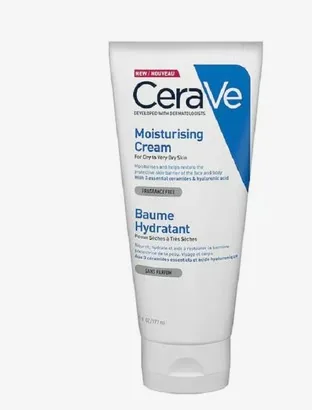
19 duels are built for this moisturizer, CeraVe Daily Moisturizing Lotion and CeraVe Moisturizing Cream among them: type a name, or pick one below.
Common questions
How high up the list is the salicylic acid (BHA) in CeraVe SA Lotion for Rough & Bumpy Skin?
Salicylic acid (BHA) is the 5th of 26 ingredients: above the 1% line. Position is the only amount the law makes a brand declare, so 5th of 26 is the one number on this label a reader can check.
What is the base of CeraVe SA Lotion for Rough & Bumpy Skin?
Water, then glycerin: a light, water-led base. The first ingredients are the bulk of a formula; the actives come after them.
Where does the 1% line fall in CeraVe SA Lotion for Rough & Bumpy Skin?
14 ingredients sit above the 1% line; from Carbomer down, the order stops telling you anything. Above it the label is in descending order by amount; below it, it need not be.
Is CeraVe SA Lotion for Rough & Bumpy Skin good for dry skin?
By our read of the formula, it suits dry, dehydrated, oily skin. CeraVe SA Lotion for Rough & Bumpy Skin is a moisturizer built around Glycerin, Salicylic acid (BHA) and Ceramide 3. It leans strongest on hydration, barrier repair, oil-control & blemishes. Best suited to dry, dehydrated and oily skin. Go slow: the active is potent enough to irritate if overused.
How do you use CeraVe SA Lotion for Rough & Bumpy Skin?
In the evening, and not every night: 2–3 times a week is plenty. Follow with a moisturiser, and wear sunscreen the next day.
What are the key ingredients in CeraVe SA Lotion for Rough & Bumpy Skin?
The actives that do the work are Glycerin, Salicylic acid (BHA), Ceramide 3, Mineral Oil, Ceramide 6-II, Ceramide 1. The rest of the list is texture, preservatives and emulsifiers that hold the formula together.
Does CeraVe SA Lotion for Rough & Bumpy Skin contain fragrance?
No. By our reading of the ingredient list it is fragrance-free, which is a plus for sensitive or reactive skin.
What the 3D scene shows
The scene shows CeraVe SA Lotion for Rough & Bumpy Skin beside a cross-section of skin, with 3 of its ingredients drawn at the layer each one acts on and at one shared molecular scale: Ceramide 3 and Glycerin and Salicylic acid (BHA) in the stratum corneum, the dead outer layer where most skincare works. Depths come from the same sourced layer data as the rest of this site, and any ingredient whose layer is not established is left out rather than guessed.