How much benzoyl peroxide do you need? 2.5 to 5%
The effective benzoyl peroxide percentage, by the vehicle-controlled trials, is 2.5 to 5%; above the 5% ceiling, more stopped adding effect or started adding irritation.
Reckon on two to four weeks. No trial pins the exact point down; that is the standard clinical expectation.
how it was measured
Measured on Inflammatory lesion count (papules and pustules), investigator-counted; the clinical consensus; no trial pins the point.PMID 2948929PMID 26048131
2.5%, Mills 1986.
Floor 2.5%: in three double-blind studies of 153 patients, 2.5% gel beat its vehicle on inflammatory lesion counts and matched 5% and 10% (Mills 1986); in 609 Japanese patients over 12 weeks, 2.5% and 5% cut inflammatory lesions 73% and 75% against 42% on placebo with no difference between them (Kawashima 2017); 3% beat vehicle in 360 patients with improvement visible from week 2 (Kawashima 2014).
What benzoyl peroxide percentage is effective?
Floor 2.5%: in three double-blind studies of 153 patients, 2.5% gel beat its vehicle on inflammatory lesion counts and matched 5% and 10% (Mills 1986); in 609 Japanese patients over 12 weeks, 2.5% and 5% cut inflammatory lesions 73% and 75% against 42% on placebo with no difference between them (Kawashima 2017); 3% beat vehicle in 360 patients with improvement visible from week 2 (Kawashima 2014).
2.5 to 5%
The trials, and what they used
- Ceiling 5%: 10% added desquamation, erythema and burning over 2.5% without adding effect (Mills 1986), so the reader's sentence is that 2.5% does the job and 10% adds irritation.
- The US monograph allows 2.5 to 10% (21 CFR 333.310); in the EU benzoyl peroxide is a medicine, not a cosmetic ingredient.
Is more than 5% benzoyl peroxide better?
No: the trials that compared doses put the ceiling at 5%, and above it more stopped adding effect or started adding irritation, so a percentage above 5% reads as above the range, not as stronger. The highest dose tested in leave-on use was 10% (Mills 1986), and the paper reports more irritation there.
Desquamation, erythema, and symptoms of burning with the 2.5% gel were less frequent than with the 10% preparation but equivalent to the 5% gel.
The highest dose tested, in the paper’s words
- Desquamation, erythema, and symptoms of burning with the 2.5% gel were less frequent than with the 10% preparation but equivalent to the 5% gel.
Neither number settles what more does. The trials that compared doses put the ceiling at 5%: above it, more stopped adding effect or started adding irritation, which is why a declared percentage above 5% reads as above the range, not as stronger.
What does the benzoyl peroxide percentage on a label tell you?
A name that states a percentage ("Benzoyl Peroxide 5%") is the only amount a cosmetic label ever declares, so it is the one number that can be read against the trials: inside 2.5 to 5%, above the 5% ceiling, or below the 2.5% floor.
A name without a percentage leaves the position. The rules make a brand list ingredients in descending order of amount down to 1%, and in any order below it, so benzoyl peroxide above the 1% line is at least 1% and benzoyl peroxide below it can be any trace the brand likes. The floor the trials worked from is 2.5%, and a position alone cannot tell you whether a label reaches it.
The benzoyl peroxide percentages in our catalogue
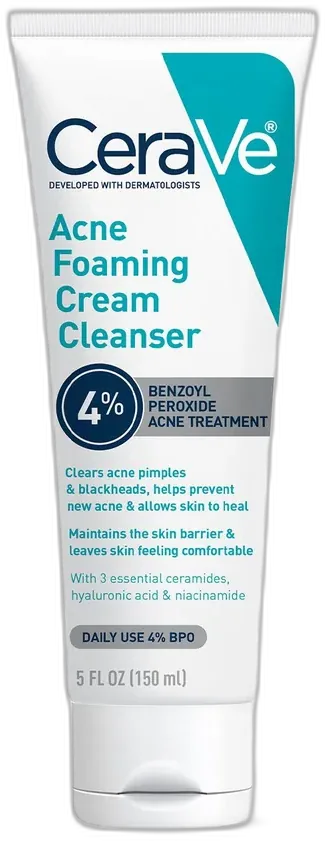
One label carries it without a number, so the position is all there is:
- CeraVe Acne Foaming Cream CleanserBenzoyl Peroxide sits 1st of 28, above the 1% line; the label does not say how much, and the trials worked from 2.5%.
Read on
- Benzoyl Peroxide: the glossary page what it does, who it suits, where it fits
- Benzoyl Peroxide vs Niacinamide
- Benzoyl Peroxide vs Azelaic Acid
- Benzoyl Peroxide vs Succinic Acid
- Benzoyl Peroxide vs Sodium Ascorbyl Phosphate
- Benzoyl Peroxide vs Sulfur
- Benzoyl Peroxide vs Zinc PCA
Other actives with a dose the trials pinned:
- Niacinamide 2%+
- Vitamin C (LAA) 5%+
- Retinol 0.075 to 0.3%
- Salicylic acid (BHA) 0.5%+
- Lactic acid 8%+
- Glycolic acid 5%+
- Retinal 0.05 to 0.1%
- Retinyl Retinoate 0.06%+
- Tretinoin 0.025%+
- Adapalene 0.1%+
- Tazarotene 0.045%+
- Azelaic Acid 15%+
- THD Ascorbate 1%+
- Sodium Ascorbyl Phosphate 5%+
- Palmitoyl Pentapeptide-4 0.0003%+
- Caffeine 2%+
- Tea Tree Oil 5%+
- Hydroquinone 4%+
- Bifida Ferment Lysate 10%+
- Thiamidol 0.2%+
- Cysteamine 5%+
- Menthol 0.1 to 5%
- Peppermint Oil 0.5%+
- N-Acetyl Glucosamine 2%+
- Alpha Lipoic Acid 5%+
- Ammonium lactate 12%+
- Acetylated Hyaluronic Acid 0.1%+
- 4-n-Butylresorcinol 0.1%+
- 4-t-Butylcyclohexanol 0.4%+
- Sphingomonas Ferment Extract 2%+