How much retinal do you need? 0.05 to 0.1%
The effective retinal percentage, by the vehicle-controlled trials, is 0.05 to 0.1%; above the 0.1% ceiling, more stopped adding effect or started adding irritation.
Give it three months or more: that is when the change first became measurable.
how it was measured
Measured on crow's-feet wrinkle depth and surface roughness, silicone-replica optical profilometry, versus vehicle; the first visit at which the change was measurable.PMID 9843009PMID 29663701PMID 41729119
0.05%, Creidi 1998.
Floor 0.05%: 0.05% retinaldehyde cream reduced crow's-feet wrinkle and roughness features on silicone replicas at week 18 where its vehicle changed nothing, 125 patients randomised to retinaldehyde, retinoic acid or vehicle (Creidi 1998).
What retinal percentage is effective?
Floor 0.05%: 0.05% retinaldehyde cream reduced crow's-feet wrinkle and roughness features on silicone replicas at week 18 where its vehicle changed nothing, 125 patients randomised to retinaldehyde, retinoic acid or vehicle (Creidi 1998).
0.05 to 0.1%
The trials, and what they used
- Ceiling 0.1%, on tolerance rather than effect: Saurat 1994 applied 0.05, 0.1 and 0.5% for 1 to 3 months and found epidermal thickening rising with dose, but in 229 patients the 1% preparation was tolerated by only 70% and 0.5% only slightly better, while 0.05 and 0.1% allowed years of use.
- Direct comparisons of 0.1 against 0.05%: no difference in texture, water loss or hydration in 40 Korean women over 3 months, only the melanin index favoured 0.1% (Kwon 2018); larger wrinkle reductions with 0.1% in 56 women over 24 weeks, split-face (Deda 2026).
- Read again on 2026-09-21: We compared the activity and tolerance profile of a 0.05% retinaldehyde cream with a 0.05% retinoic acid cream and the retinaldehyde vehicle in patients with photodamaged skin of the face.
- (PMID 9843009)
Is more than 0.1% retinal better?
No: the trials that compared doses put the ceiling at 0.1%, and above it more stopped adding effect or started adding irritation, so a percentage above 0.1% reads as above the range, not as stronger. The highest dose tested in leave-on use was 1% (Saurat 1994), and the paper reports more irritation there.
In pilot clinical tolerance studies, 229 patients received topical retinaldehyde at different concentrations; the 1% preparation was tolerated by up to 70% of…
The highest dose tested, in the paper’s words
- In pilot clinical tolerance studies, 229 patients received topical retinaldehyde at different concentrations; the 1% preparation was tolerated by up to 70% of the treated subjects; tolerance of the 0.5% preparation was slightly better, whereas both 0.1 and 0.05% preparations applied on facial skin were well tolerated and allowed prolonged use (up to 3 years) in patients with inflammatory dermatoses.
Neither number settles what more does. The trials that compared doses put the ceiling at 0.1%: above it, more stopped adding effect or started adding irritation, which is why a declared percentage above 0.1% reads as above the range, not as stronger.
What does the retinal percentage on a label tell you?
A name that states a percentage ("Retinal 0.1%") is the only amount a cosmetic label ever declares, so it is the one number that can be read against the trials: inside 0.05 to 0.1%, above the 0.1% ceiling, or below the 0.05% floor.
A name without a percentage leaves the position. The rules make a brand list ingredients in descending order of amount down to 1%, and in any order below it, so retinal above the 1% line is at least 1% and retinal below it can be any trace the brand likes. The floor the trials worked from is 0.05%, and a position alone cannot tell you whether a label reaches it.
The retinal percentages in our catalogue
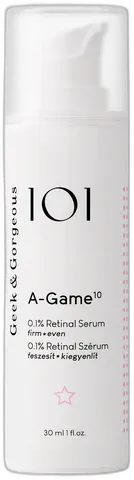 12th of 22Geek & Gorgeous A-Game 10
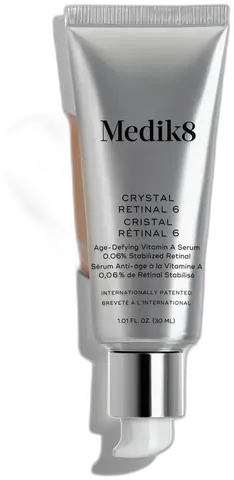 29th of 47Medik8 Crystal Retinal 6
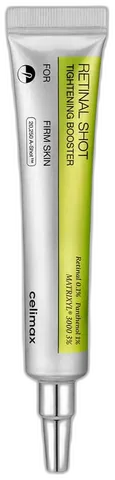 20th of 32Celimax The Vita A Retinal Shot Tightening Booster
3 labels carry it without a number, so the position is all there is:
- Geek & Gorgeous A-Game 10Retinal sits 12th of 22, above the 1% line; the label does not say how much, and the trials worked from 0.05%.
- Medik8 Crystal Retinal 6Retinal sits 29th of 47, below the 1% line; the label does not say how much, and the trials worked from 0.05%.
- Celimax The Vita A Retinal Shot Tightening BoosterRetinal sits 20th of 32, below the 1% line; the label does not say how much, and the trials worked from 0.05%.
Read on
- Retinal: the glossary page what it does, who it suits, where it fits
- Retinal vs Niacinamide
- Retinal vs Vitamin C (LAA)
- Retinal vs Retinol
- Retinal vs Hydroxypinacolone Retinoate
- Retinal vs Retinyl Palmitate
- Retinal vs Retinyl Acetate
Other actives with a dose the trials pinned:
- Niacinamide 2%+
- Vitamin C (LAA) 5%+
- Retinol 0.075 to 0.3%
- Salicylic acid (BHA) 0.5%+
- Lactic acid 8%+
- Glycolic acid 5%+
- Retinyl Retinoate 0.06%+
- Tretinoin 0.025%+
- Adapalene 0.1%+
- Tazarotene 0.045%+
- Azelaic Acid 15%+
- THD Ascorbate 1%+
- Sodium Ascorbyl Phosphate 5%+
- Palmitoyl Pentapeptide-4 0.0003%+
- Caffeine 2%+
- Benzoyl Peroxide 2.5 to 5%
- Tea Tree Oil 5%+
- Hydroquinone 4%+
- Bifida Ferment Lysate 10%+
- Thiamidol 0.2%+
- Cysteamine 5%+
- Menthol 0.1 to 5%
- Peppermint Oil 0.5%+
- N-Acetyl Glucosamine 2%+
- Alpha Lipoic Acid 5%+
- Ammonium lactate 12%+
- Acetylated Hyaluronic Acid 0.1%+
- 4-n-Butylresorcinol 0.1%+
- 4-t-Butylcyclohexanol 0.4%+
- Sphingomonas Ferment Extract 2%+